

Aliphatic Alcohol 101
If you work with concrete, you’ve probably seen the words “aliphatic alcohol” on a drum or “evaporation retarder” in your concrete specification at some point, but what does it actually do? Let’s take a look.
An Australian summer can be one of the most challenging times to place concrete. Hot or high wind conditions can create some of the hardest environments for achieving a good concrete surface finish. When we don’t look after concrete, this often results in major cracking issues, leaving us with both aesthetic and structural problems. So why does this happen, and how can we avoid it?

What is Aliphatic Alcohol?
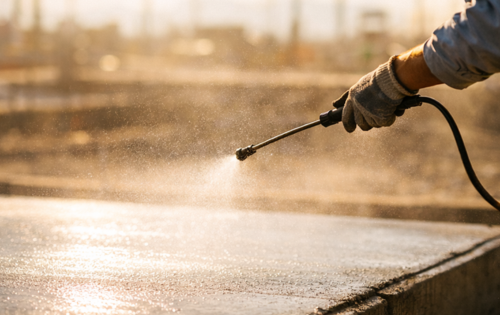
Aliphatic alcohols are spray applied ‘evaporation retarders’ used to control moisture loss from the surface of freshly placed concrete during finishing. Sprayed as a fine mist, aliphatic alcohol forms a temporary monomolecular (single molecule thick) film/moisture barrier. When applied correctly, aliphatic alcohol will not affect strength, colour or interfere with curing compounds.
NOTE: Aliphatic alcohol is NOT a curing compound or substitute for a curing compound. It only provides short-term protection while the concrete is being finished and disappears as the surface dries or is worked. In accordance with AS 3600:2018, “concrete shall be cured to minimise plastic and drying shrinkage cracking and to promote adequate hydration of the cementitious materials”.
How does Aliphatic Alcohol Work?
Looking after concrete during placement is critical to your pour’s success. As it transitions from a plastic to a hardened state, this is when concrete is most vulnerable to cracking issues.
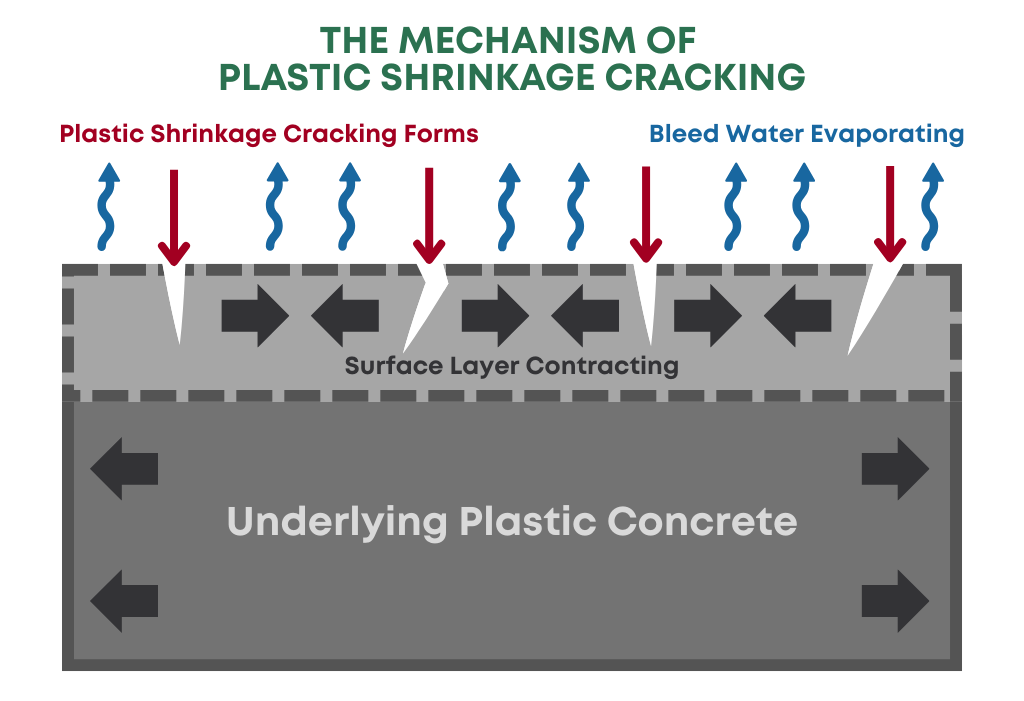
During finishing, bleed water rises through the concrete as the heavier cement and aggregate particles settle. When the surrounding air is hot, dry, or windy, it draws moisture from the surface faster than the bleed water can replace it. If this moisture evaporates too quickly, the surface layer begins to dry and shrink before it has gained sufficient tensile strength. The still-plastic concrete beneath resists this movement, creating tensile stress fractures at the surface, known as plastic shrinkage cracking (AS 3600 Appendix B — Early-Age Cracking Mechanisms).
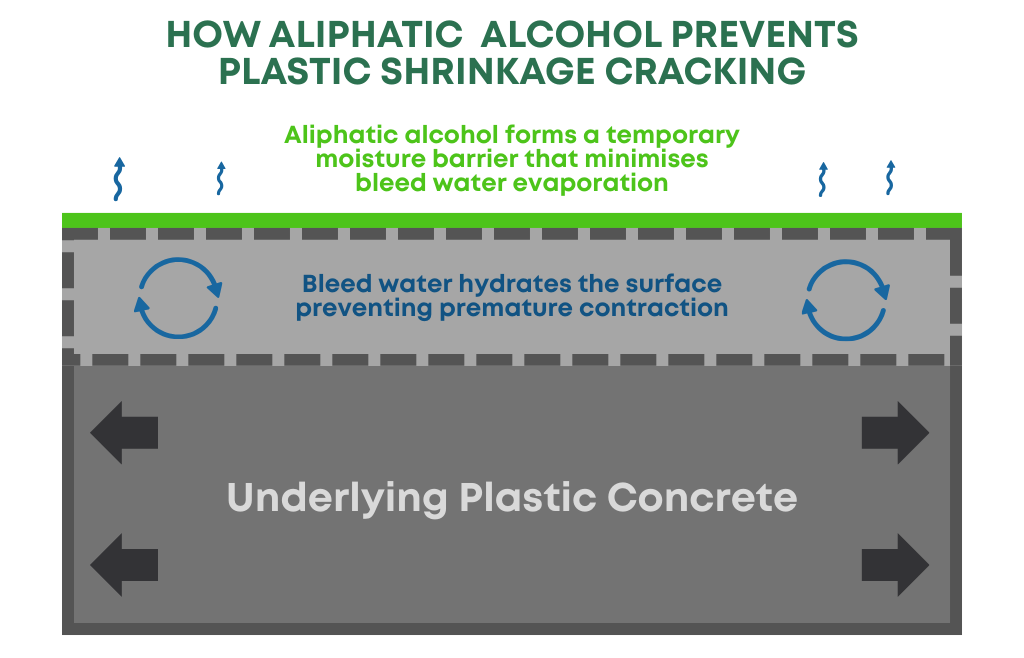
Aliphatic alcohol forms a thin, permeable moisture barrier between the concrete surface and the surrounding air, slowing the rate of evaporation and helping retain bleed water at the surface. By keeping this moisture film in place, it prevents the surface from drying and shrinking prematurely, allowing the cement particles to hydrate properly and gain enough tensile strength to resist cracking.
In severe weather conditions or when the surface is disturbed during finishing the protective film can be broken. In these cases, aliphatic alcohol should be re-applied several times to maintain an effective cover, such as after bullfloating, trowelling, or other surface operations. An easy rule of thumbs is reapply often, especially have the surface bleed water is moved about in anyway. In extreme conditions, five or six light applications may be required to maintain finish quality. However, do not apply aliphatic alcohol if the bleed water sheen has gone from the surface.
Why Use Aliphatic Alcohol?
Why not just add more water on top? Well, that’s a trap for young players and old heads alike. Adding water to the surface of concrete during finishing can lead to a weakened surface and cause crazing or dusting.
Aliphatic alcohol provides a simple and effective solution for hot and dry conditions by maintaining surface moisture during finishing. By controlling moisture loss, it keeps the concrete workable for longer, allowing finishers to work without resorting to spraying with additional water or over-trowelling.
Aliphatic alcohol is particularly useful when:
- Working in hot and dry weather
- Placing in high winds or on exposed decks
- Completing decorative, polished or coloured concrete where surface appearance is critical
“During summer, cracking can appear before you even finish a slab. Taking the time for a quick spray of aliphatic alcohol will make all the difference.”
– David Ashton, CE Construction Solutions.
Aliphatic Alcohol FAQ
Can I pour in extreme conditions if I use aliphatic alcohol?
Not exactly. Aliphatic alcohol helps control surface evaporation, but it’s not a substitute for good hot-weather concreting practices. You should still manage placement timing, shade, windbreaks and plan your pour to stay within AS 1379 and AS3600 limitations.
Is aliphatic alcohol a replacement for curing compounds?
No, it only provides temporary protection during finishing. Always apply a proper curing compound after the bleed water has fully evaporated.
Does it affect curing time?
No. It only controls surface evaporation during finishing and has no effect on the concrete’s overall curing rate or strength development.
Why not just mist or a hose instead of aliphatic alcohol?
While fogging or lightly misting the surface with water might seem like an easy fix, it’s inconsistent and can add unwanted water to the mix, changing the water/cement ratio and weakening the surface. Aliphatic alcohol provides a controlled, uniform film that slows evaporation without adding water.
Can I use it after the surface starts to dry?
No. Aliphatic alcohol should be applied while bleed water is still visible. Once the surface has started to dry, it won’t reverse shrinkage cracking risk.
Will it affect the final finish or colour?
No, while some aliphatic alcohols contain a temporary coloured dye to show where they have been sprayed, it evaporates or breaks down leaving no residue or discolouration when used correctly.
How is it applied?
Typically sprayed using a fine mist sprayer at the recommended coverage rate for the product you are using.
When should I apply it?
Apply aliphatic alcohol as soon as bleed water has started to appear and collect evenly on the surface. Applying it too early can cause it to mix into the concrete rather than forming a film, while applying it too late allows excessive evaporation that can lead to surface drying and plastic shrinkage cracking.
Can I use aliphatic alcohol with admixtures?
Yes. Aliphatic alcohol is applied to the surface, not mixed into the concrete, so it won’t interfere with admixtures such as plasticisers, accelerators, retarders, or air entrainers. However, admixtures can influence the bleed rate, for example, mixes with water reducers or supplementary cementitious materials tend to bleed less. This means the timing of aliphatic alcohol application may need to be adjusted accordingly.
How much does it cost?
Prices will vary based on various brands available, labour cost and number of times the aliphatic is applied. A 20ltr drum of BERRAKURE AA as an example will dilute 1:9 with water to create 200ltrs of material, this is applied at a rate of 5m2 per litre, therefore 1000m2. At $130.00 per drum this is a m2 rate of $0.13/m2 making it a very cost effective solution.